Refugee women's contact with Dutch society often stays shallow and rarely turns into real relationships.
Source: SCP, 2021
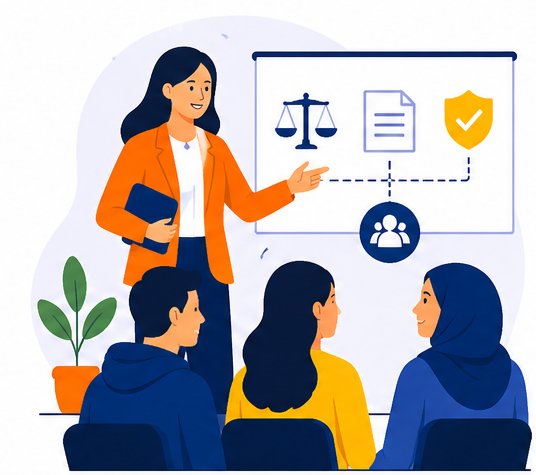
Municipal guidance often starts with the man, so women can drop out of view.
Source: KIS, 2018
The plan
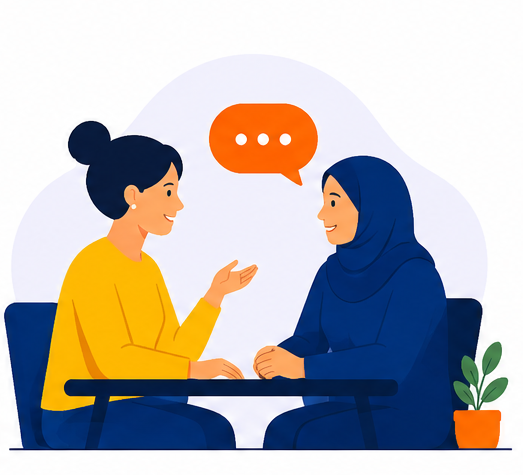
Five refugee women will be employed as paid peer leaders.
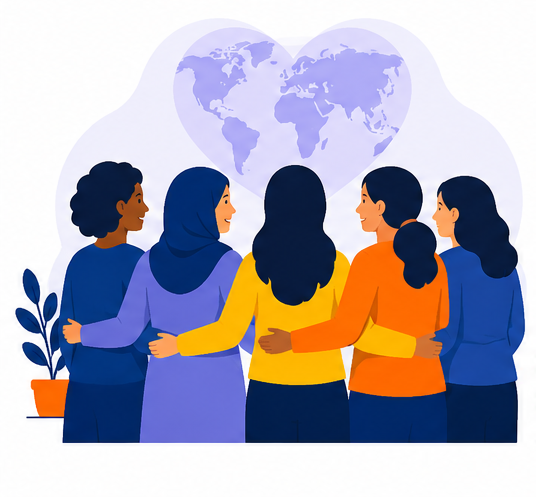
They will bring 60 to 80 women together in weekly groups.
The groups will connect them to organisations and institutions in Amsterdam.
Co-designed: the programme will be shaped together with refugee women, using design thinking.
Participants will be matched with peer leaders using FSAI, a peer-matching tool developed as a separate CBB project.
Planned timeline
PHASE 1 · MONTHS 1 TO 4
Co-design and training
PHASE 2 · MONTHS 5 TO 10
Community activation
PHASE 3 · MONTHS 11 TO 12
Consolidation
A shared knowledge base will be published, and the network will continue on a voluntary basis.
Month 1 begins once funding is confirmed.
The peer leaders
Five peer leaders will be recruited from refugee communities.
They will work in teams of 2 to 3 per session.
PLANNED LANGUAGE MIX
Arabic
Ukrainian
Tigrinya
Turkish
What WISE aims to build
Bonds
Stronger ties among the women themselves.
Bridges
New connections with the wider Amsterdam community.
Links
Easier access to institutions and services.
Based on Ager and Strang’s integration framework.
Our goals
TARGETS
women taking part
60 - 0
paid peer leaders
0
women in a volunteer network that continues after the project
0+
Our Partners
Support Project WISE
We are looking to collaborate with funders, academic institutions, community organisations, and public bodies interested in early-stage social innovation.
Contact us at info@codersbeyondborders.org or visit our contact page.