For refugees, asylum seekers, and underserved communities, the challenge is rarely the system alone. It is the absence of clear, reliable, and accessible information about how to navigate it. Legal and administrative processes are written in formal language, scattered across institutions, and difficult to act on without expert support.
Missed deadlines. Foregone rights. Avoidable crises. When people cannot understand the systems that govern their lives, the cost falls on those who can least afford it.
Organizations supporting these communities face growing need with limited capacity to provide individual guidance at scale.
Factstream AI is a responsible AI platform that makes legal and civic information accessible, understandable, and actionable. It is designed for refugees, asylum seekers, underserved communities, and the non-profit organizations that serve them.
Complex legal content, rights, procedures, and public services are translated into clear, straightforward language people can actually use.
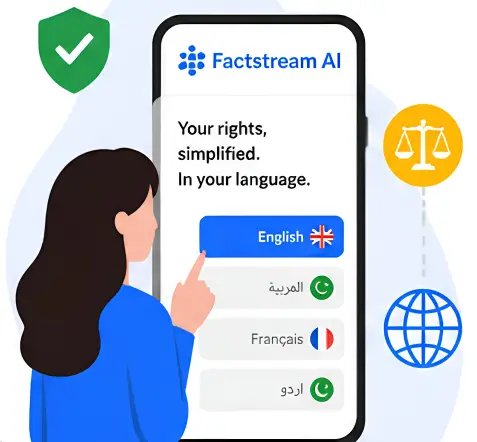
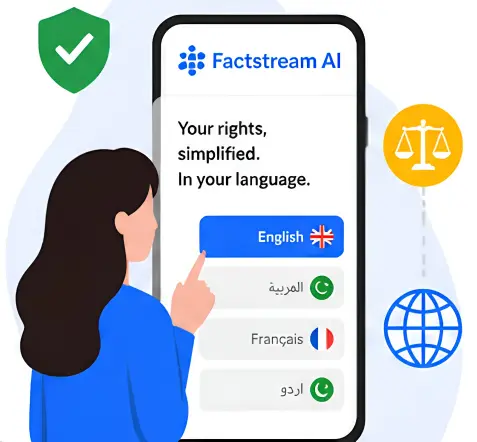
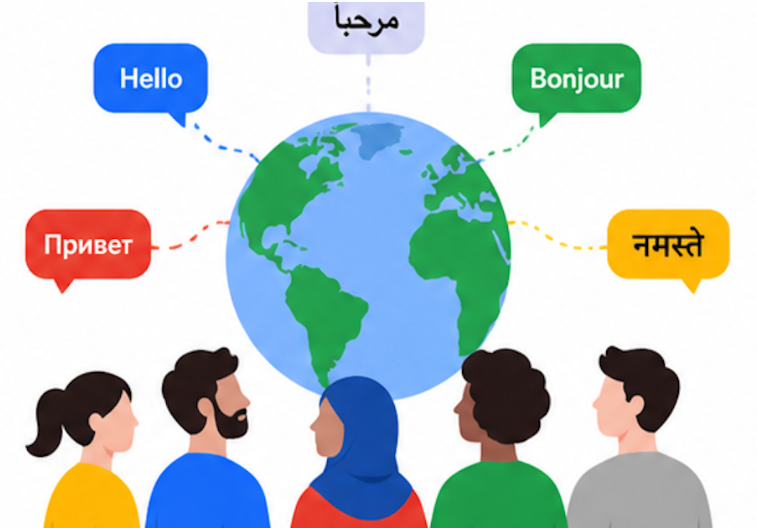
Information is made available in languages commonly spoken by newcomer communities, removing language as a barrier to understanding.
Factstream AI helps users understand their situation and identifies the right next step, whether that is learning more, finding a trusted service, or connecting to legal support.
When a question requires professional input, the platform connects users to relevant organizations, legal professionals, and community services.
Factstream AI also supports the organizations working with these communities, giving them a scalable tool to improve information access and inclusion outcomes.
Access to information is a foundation for integration, participation, and justice. When people cannot understand the systems that govern their lives, the consequences are real: missed deadlines, foregone rights, avoidable crises.
Factstream AI addresses a structural gap that existing services cannot fully meet, using responsible AI to extend reach without replacing the human relationships and institutions that communities depend on.
Factstream AI has been presented and recognized at the Paris Peace Forum, MWC Barcelona Talent Arena, and the Amsterdam Law Hub, where it received the Best Access to Justice Platform Award.
Factstream AI is developed with trust, accountability, and sustainability as foundations, not afterthoughts.
Our infrastructure runs on secure European servers, fully compliant with GDPR and the EU AI Act. User data stays in Europe, handled with strict data minimization and anonymization practices at every stage. We run on open-source, European-developed large language models, keeping the technology aligned with our values on accountability and sovereignty.
We use a citation-based architecture that significantly reduces hallucinations and allows users to verify every answer against its original source directly. Document processing capabilities, including OCR, let users see exactly where information comes from, highlighted in the source document itself.
AI supports, but does not decide. Outputs are continuously reviewed in collaboration with legal experts, non-profit legal clinics, and the University of Amsterdam Law Hub. We maintain a clearly defined boundary between information support and professional legal advice.
Our system is optimized for cost efficiency and powered by 100% renewable energy, reducing the carbon footprint of every interaction. We run on open-source, European-developed large language models, keeping the technology aligned with our values on accountability and sovereignty.
Working with vulnerable communities requires a higher standard of responsibility. Every design decision, from how data is processed to how answers are presented, reflects that.
WHAT IT IS
Legal and civic information made accessible, understandable and actionable for refugees, asylum seekers, underserved communities, and the nonprofits serving them.

Legal content rewritten in clear, direct wording, in the language the person speaks.

Every claim points back to an official legal text or partner-reviewed content.

Questions that need legal advice reach a lawyer instead of an answer.
THE PROBLEM

They do not know what to ask, or who to ask.

One question can touch the IND, the COA, the municipality and a lawyer.

Missed deadlines, forfeited rights and avoidable crises.

Caseworkers spend their hours answering the same questions.
EVIDENCE BASE
Dutch Senate vote, 21 April 2026
41 for, 34 against
Splits refugee status from subsidiary protection. Tightens family reunification.
31 for, 44 against
The stricter package did not pass.
37 for, 38 against
Undocumented stay is not criminalised. A new proposal was announced.
What travels through a community WhatsApp group is one sentence: “the asylum laws passed.” That sentence is partly true, which is what makes it dangerous.
EVIDENCE BASE
How 197 newcomers heard about the vote, and what they understood from it
Almost no one was left uninformed.
EVIDENCE BASE
said it was not clear, or only partly clear, what the outcome meant for their own situation.
Reach is not the same thing as understanding.
EVIDENCE BASE
Where respondents expect the change to affect them most, scored 0 to 100
Almost no one was left uninformed.
expect a large effect on their own life or their family’s. Only 7.1% expect none.
SURVEY TWO, JUNE 2026
A second Survey Panel poll, on the new EU asylum and migration rules
THE PROBLEM
say they know well what the changes mean for them. The rest are unsure, do not know whether the old or the new rules apply, or cannot tell whether the rules apply to them at all.

Named most often

Named nearly as often

Named much less often
About one in three say they receive no clear information at all. At the time of writing, no institutional initiative to organise information provision was known. Civil society is filling the gap.
Source: OpenEmbassy, “Nieuwkomers over het Migratiepact”, Survey Panel flash survey fielded June 2026, published 1 September 2026. Exploratory, not a representative sample.
- IN THEIR OWN WORDS
Every staff member says something different.
Survey respondent, describing calls to the IND. OpenEmbassy, May 2026.
Uncertainty wears a person down.
Survey Panel respondent. OpenEmbassy, June 2026.
Two surveys, three months apart. When the official source is inconsistent, or absent, rumour fills the space.
Sources: OpenEmbassy flash surveys, “Nieuwkomers over het tweestatusstelsel” (May 2026) and “Nieuwkomers over het Migratiepact” (published 1 September 2026). Both exploratory, not representative samples.
- IN THEIR OWN WORDS
Where respondents expect the change to affect them most, scored 0 to 100
name the possibility of obtaining permanent status later as a main concern. June 2026.
Long-term uncertainty makes it harder to focus on language, work or inburgering.
01 Who the law applies to, and from when
02 What it means for residence status
03 What it means for family reunification
04 Whether rules apply retroactively
05 What steps exist if the outcome is bad
Sources: OpenEmbassy flash surveys, “Nieuwkomers over het tweestatusstelsel” (May 2026) and “Nieuwkomers over het Migratiepact” (published 1 September 2026). Both exploratory, not representative samples.
- WHAT PEOPLE ASKED FOR
Most named support needs, June 2026, and what Factstream AI does
THE NEED
WHAT WE BUILT
Source: OpenEmbassy, “Nieuwkomers over het Migratiepact”, Survey Panel flash survey fielded June 2026, published 1 September 2026. Exploratory, not a representative sample.
- AN INDEPENDENT RECOMMENDATION
OpenEmbassy’s recommendations, published 1 September 2026, alongside what Factstream AI already does
Confidence level on every answer
Human escalation to a pro bono lawyer
Delivery in the channels communities use
A clear answer and a named next step
FACTSTREAM AI
THE PRODUCT
Three conditions an answer has to meet before a person ever sees it

CHECK 1
Answers are drawn from official legal texts and partner-reviewed content, not from open web material.

CHECK 2
Every claim carries a source. Every answer carries a confidence level, so the user can see how far to trust it.

CHECK 3
Low confidence, or a question that needs legal advice, routes to a pro bono lawyer instead of a guess.
ALL THREE HOLD
The answer is shown, with its source attached.
ANY ONE FAILS
The question goes to a person, not to a guess.
Factstream AI does not broadcast news. It answers one person's question, in their own language, and says so when it does not know.
THE PRODUCT
Complex legal content rewritten in clear, direct wording.
Answers in the languages newcomer communities speak.
Helps a person place their own situation and see the next step.
Routes to organisations, legal professionals and community services.
Scalable resources for the organisations already carrying this work.
HOW IT WORKS
Verified sources only
Official legal texts and partner-reviewed content.
The question
Asked by one person, in their own language.
Retrieval with citation
Every claim points back to a source.
A confidence level
Attached to the answer the user sees.
Human escalation
When confidence is low or the case needs advice.
HOW IT WORKS
Working with people in vulnerable situations requires a higher standard. Each layer holds the one above it.

Higher accountability standards, because the users are vulnerable.
Outputs reviewed with legal experts and nonprofit legal clinics. AI supports, it does not decide.
Citation-based architecture. Every answer can be checked against its original source.
European servers. GDPR applied and building to the EU AI Act. Data minimised and de-identified.
USE CASES
We co-design Factstream AI with local nonprofits, so it adapts to the communities each partner serves, not a one-size-fits-all tool.
For migrant workers facing exploitation at work.
Guidance for people seeking recognition and redress.
Safe, private information on rights and protection.
Rights information that reaches young people inside.
Tailored pathways for people facing specific risks.
GBV survivors, unaccompanied minors, people in asylum procedures.
We are actively looking to collaborate with funders, legal organizations, public institutions, universities, and civil society partners who share our commitment to inclusion and access to justice.
If you are interested in supporting or partnering with Factstream AI, we would be glad to connect.
One of our team members will contact you shortly
Fill out the contact form below, and one of our team members will get back to you as soon as possible.